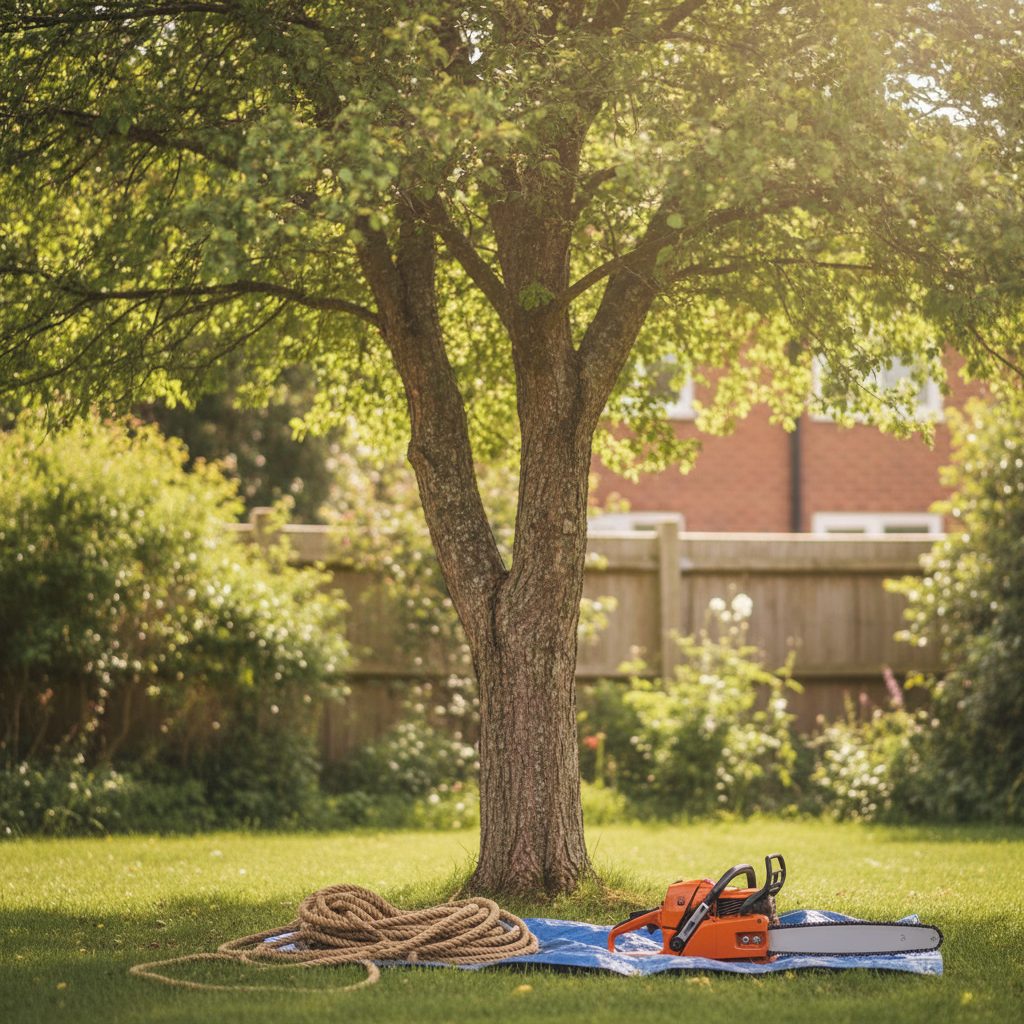
How arborists actually price a removal
Tree removal is not sold at a flat per-tree rate. Crews start from a base figure for felling and hauling a typical mid-size tree, then multiply it up or down based on what makes the job harder or easier. Height and trunk diameter matter most, because a taller, thicker tree takes more cuts, more rigging, and more truck loads. After that, access decides how much of the work has to be done by hand versus with equipment: a tree with room for a bucket truck comes down faster than one wedged against a fence or power line, where every section gets lowered on a rope. Stump grinding is priced as its own line, almost always separate from the felling and hauling charge. None of this scales in a straight line. A tree twice as tall does not cost twice as much. It usually costs more than that, because working at height compounds every other variable.
Work out your tree removal cost
Use the calculator above: pick your tree size, note whether it's near a structure or power line, decide if you want the stump ground down too, and enter your ZIP so the range reflects your local labor market. The result is a spread, not a single number, because two arborists looking at the same tree can land a few hundred dollars apart depending on their overhead and equipment.
Typical tree removal cost by scenario
| Job | What it usually runs |
| Small tree (under 30 ft) | $150 - $500 |
| Medium (30-60 ft) | $400 - $1,200 |
| Large (60-80 ft) | $1,000 - $2,500 |
| Very large (80 ft+) | $2,000 - $5,000 |
| Stump removal (add-on) | $150 - $600 |
What moves the number up or down
- Tree height and diameter. Taller, thicker trees take more labor, more time, and more equipment to move.
- Access and hazards. Proximity to homes, fences, and power lines means careful rigging, which costs more.
- Stump removal. Grinding or full extraction is almost always a separate line item.
- Emergency or storm work. Fallen or hazardous trees command a premium for urgent response.
- Debris hauling. Taking away the logs and chips can add a fee, or you can keep the wood.
- Location. Regional labor rates and local permit requirements both affect the bottom line.
Tree removal questions, answered
How much does tree removal cost?
Most removals run $400 to $2,000. Very large trees can reach $5,000 or more.
Does homeowners insurance cover tree removal?
Sometimes. If a tree falls and damages an insured structure, your policy often covers the removal along with the damage claim. Routine removal of a healthy standing tree is rarely covered.
How much does stump removal cost?
Stump grinding typically adds $150 to $600, depending on the stump diameter and how many you have.
Why does tree size matter so much?
Taller trees with larger trunks need more labor, heavier equipment, and more careful rigging to bring sections down safely. The price does not scale linearly with height.
Do I need a permit to remove a tree?
Some cities require a permit, especially for large or protected species. Check with your municipality before scheduling any removal work.
What is the average price to cut down a tree?
Most single-tree removals run $300 to $1,500, with the median around $700. Small trees under 30 feet tend to cost $150 to $500. Large trees over 60 feet can run $1,500 to $3,000 or more. Trunk diameter, proximity to structures, and stump removal all affect the final number.
How much does it cost to remove a tree?
Costs range from $150 for a small open-yard tree to $3,000 or more for a very large or hazardous one. A typical job falls between $400 and $1,200. Emergency removal, tight access, and trees near power lines push the number higher. Getting quotes from two or three certified arborists is the most reliable way to land on a fair price.
How to get your trees cut down for free?
If a tree poses a direct threat to power lines, contact your local utility first. Some utilities remove those trees at no charge. Municipal programs occasionally cover removal of invasive species or storm-damaged trees, so it is worth checking with your city or county. Firewood buyers will sometimes offset removal costs in exchange for taking the wood.
What is the 5 15 90 rule tree felling?
The 5-15-90 rule is a safety guideline for tree felling. Stay at least 5 times the tree height away from the base as a minimum safe distance, keep a 15-degree lean tolerance before needing specialized rigging, and maintain a 90-degree retreat path at a 45-degree angle from the intended fall direction. Arborist and chainsaw safety training programs teach this rule. Homeowners should leave the felling of large or hazardous trees to certified professionals.
In-depth tree removal guides
See what it costs to get it done
Tree work is priced by size and risk, not a flat rate, which is exactly why two arborists can quote the same tree $500 apart. Two or three written quotes from licensed local arborists is still the most reliable way to land on a fair number, and asking costs nothing.
Ready to stop guessing?
Three arborists looking at the same tree rarely land on the same number. Ask a few and compare.Request local quotes
This page sometimes earns a referral fee when a request turns into a booking. What you pay the arborist is unaffected.